
Textile stocks have exhibited a mixed performance so far this calendar year (CY23), amidst higher domestic cotton prices and tepid global demand. Shares of Page Industries, Dollar Industries, Lux Industries, and VIP Clothing have declined up to 13 per cent so far in CY23, as against a 9 per cent jump in the S&P BSE Sensex. On the contrary, shares of Arvind, Welspun India, Raymond, and Gokaldas Exports have gained up to 51 per cent, during the same period.

India's total value of defence production breached Rs 1 trillion-mark in the fiscal year 2022-23 (FY23), up 12 per cent year-on-year (YoY). At the bourses, this has been well reflected in related-stocks from the sector as they gained considerable ground during this period. Shares of Hindustan Aeronautics (HAL), Mazagon Dock Shipbuilders, MTAR Technologies, Bharat Electronics (BEL), and Bharat Dynamics (BDL) have skyrocketed up to 160 per cent in a year, as against a 14 per cent jump in the S&P BSE Sensex.

After a sharp fall in the share prices of HDFC Bank and other private sector lenders in the past three days, the BFSI (banking, financial services and insurance) sector weighting in the Nifty50 has slipped to a seven-year low of 32.03 per cent, down from nearly 36.6 per cent at the end of March 2023 and 34.5 per cent at the end of December 2023.

Among the Sensex firms, Kotak Bank, PowerGrid, ICICI Bank, HDFC Bank, PowerGrid were the major gainers. HUL, TCS, M&M, IndusInd Bank, HCL Tech were among the losers.
From the Sensex pack, Bharti Airtel, HDFC Bank, Titan, UltraTech Cement, ITC, Sun Pharma, Bajaj Finserv, Bajaj Finance, Hindustan Unilever and Kotak Mahindra Bank were among the major gainers. Tata Steel, Axis Bank, NTPC, ICICI Bank and IndusInd Bank were the major laggards.

Firms have to adhere to strict compliance requirements mandated by global parents

The joint venture of Jio Financial Services and BlackRock to foray into India's asset management space could be disruptive but not disastrous for incumbent industry players, analysts said on Thursday. As an investment strategy, analysts suggest investors stay put in shares of those AMCs that consistently improve business metrics, and where market capitalisation-to-asset under management (AUM) valuation is not stretched. However, growth expectations of incumbent players may get trimmed in the medium-to-long term, analysts said, once the Jio-BlackRock JV unveils its plans, discounting the looming challenge as significant enough to dent their profitability.

The retail inflation, which is factored in by the RBI to arrive at its monetary policy, has been on decline since last month. The previous low was 5.54 per cent in November 2019. The government has asked the RBI to restrict the inflation around 4 per cent, with a margin of 2 per cent on the either side.

Crisil Research expects retail inflation to rise 60 basis points to 4 per cent this fiscal from 3.4 per cent in 2018-19.

The Nifty Bank index has come off 15 per cent from its peak in February, underperforming the benchmark Nifty which is down 6%.

Apple's online launch is a symbol of success for FDI in single-brand retail, though there's no indication of how much the Silicon Valley major would invest in the country.

From the pandemic shocks to state polls to global trends, a raft of sentiment drivers are expected to steer the Indian stock market in 2022 after a historic year of massive investor returns and milestones. The Union Budget, which will be closely watched for further reform moves, and quarterly earnings of corporates will be among the developments on investors' radar amid global central banks moving towards tighter interest regime in the wake of inflationary pressures. The year 2021 was rewarding in a big way for equity investors.

The dream-run in railway stocks may soon run out of steam, caution analysts. The rally, which has lasted nearly a year, may meet time-wise correction post the Union Budget announcements as investors begin scalping profits. "There is going to be a build-up in expectations for the sector from the Union Budget, which is still two-odd months away.

The BSE Realty index-a gauge of real estate stocks-rose 4.2 per cent on Monday, extending its two-day advance to 7.8 per cent. The latest gains came on the back of robust sales posted by realty developers in the March quarter of financial year 2022-23 (Q4FY23). On Thursday, the rate-sensitive index had gained 2.9 per cent following the Reserve Bank of India's decision to pause interest rate hikes in its latest monetary policy review.

From the Sensex basket, Tata Motors, State Bank of India, Tata Steel, Power Grid, NTPC, Bajaj Finserv, Bajaj Finance and Asian Paints were the major laggards.

Byju's is set to promote its chief operating officer (COO) Mrinal Mohit to a bigger role, including leading the India operations, according to people familiar with the matter. This is because Byju Raveendran, founder and chief executive officer (CEO) of the edtech giant - which is valued at $22 billion - is planning to focus on global expansion and acquisitions. Among the global regions, Raveendran may look at markets such as the US and the Middle East.

Global trends and the Covid situation in China would drive the equity markets this week, which may also see volatility amid the scheduled derivatives expiry on Thursday, said analysts. According to analysts, investor sentiment remained subdued last week amid surging Covid cases in China and a few other nations. Also, stronger US growth data has cemented expectations of the Federal Reserve continuing with its hawkish stance, which added to the muted trend.

Making a stellar debut, shares of FSN E-Commerce Ventures, which runs the online marketplace for beauty and wellness products Nykaa, closed with a huge premium of over 96 per cent against the issue price of Rs 1,125 on Wednesday. The stock debuted at Rs 2,001 apiece, reflecting a jump of 77.86 per cent on the BSE. Then, the scrip zoomed 99.83 per cent to Rs 2,248.10 during the day before closing at Rs 2,206.70.
Inflation data, both at domestic and global level, interest rate scenario in the US, geopolitical situation and general elections in 2024 are some of the major factors that would influence trading in the equity market this financial year, analysts said. Besides, foreign fund trading activity and global trends will also dictate terms in the equity market going ahead. Equity markets across the globe faced major challenges in FY23 due to concerns over high inflation, which resulted in increase in interest rates around the world, lowering investor sentiment, experts added.

With a loan book of $268 billion, India's retail banking is now ahead of Russia, Malaysia and Mexico but behind China, Brazil and Thailand

India's first-ever listed new-age company, Zomato, has seen a meteoric rise in its stock price in calendar year 2023 (CY23), rising 70.75 per cent during this period as compared to 9.5 per cent rise in the S&P BSE Sensex. From being the second worst hit new-age stock in CY22, crashing 57 per cent on the National Stock Exchange (NSE), the stock hit the Rs 100-mark for the first time since January 2022 in late August. The stellar run in the stock - only after PB Fintech and One97 Communications-owned Paytm, analysts say, may be coming to an end, at least for now.

The market capitalisation of BSE-listed firms jumped to an all-time high of Rs 304.53 lakh crore on Wednesday, buoyed by an unprecedented rally in equities where the BSE benchmark Sensex ended over the 67,000-mark for the first time ever. Rallying for the fifth day running, the 30-share BSE Sensex climbed 302.30 points, or 0.45 per cent, to end at its lifetime closing high of 67,097.44 points. During the day, it jumped 376.24 points, or 0.56 per cent, to reach its all-time intra-day peak of 67,171.38 points.

Macroeconomic data announcements, global trends and trading activity of foreign investors would guide momentum in the equity market this week, analysts said. Markets ended a five-week losing streak and gained nearly a per cent last week, helped by a sharp rebound on Friday. Last week, the BSE benchmark jumped 500.65 points or 0.77 per cent and the Nifty gained 169.5 points or 0.87 per cent.
Leading stock exchange BSE has decided to discontinue Stop Loss Market (SL-M) orders from October 9 to prevent erroneous order placement arising out of manual or algo trades. This came after a recent freak trade incident caused a lot of angst among the trading community earlier this month due to an SL-M order. SL-M is a type of order that automatically sells or buys a security at the market price when the trigger price is reached.
Wholesale price inflation remained in the negative territory for the fourth month in a row in July at (-)1.36 per cent, even though prices of food items, especially vegetables, skyrocketed. The inflation, however, has inched up from (-)4.12 per cent recorded in June fuelled by 62.12 per cent rise in vegetable prices. In July last year, wholesale price index (WPI) was 14.07 per cent.

Oil to telecom conglomerate Reliance Industries (RIL) has initiated the process to seek shareholders' approval for the appointment of the third generation of the Ambani family on the company's board. The remote voting through postal ballot will start from September 27 onwards. In a separate note, CreditSights said a trust and hold-co model could be a possibility for the anticipated succession at RIL.

India's industrial production grew by 1 per cent in December, official data showed on Friday. According to the Index of Industrial Production (IIP) data, the manufacturing sector output grew by 1.6 per cent in December 2020.
The Reserve Bank of India's interest rate decision, domestic macroeconomic data and global trends will dictate terms in the equity markets this week, analysts said. Trading activity of Foreign Portfolio Investors (FPIs) will also influence markets, they added. "The Indian market will be closely monitoring the Reserve Bank of India's Monetary Policy Committee (MPC) meeting scheduled for June 6-8, 2023. Aside from that, market participants will be keeping an eye on the progress of monsoon," said Pravesh Gour, Senior Technical Analyst, Swastika Investmart Ltd.

The Nifty IT index rose by 5.14 per cent on Friday (January 12), marking its best performance in a day since July 2020, followed by another 1.9 per cent rally on Monday. With this, the index, which tracks the share prices of India's 10 biggest information technology (IT) services companies, has increased 7.1 per cent in the past two sessions. However, the substantial rally in the index occurred at a time when India's four largest IT companies reported their worst quarterly performance in over five years.

Small stocks of Dalal Street grappled with turbulent times in 2022 as high volatility and higher interest rate regime sapped investors' appetite for these scrips but the horizon ahead seems less cloudy for the New Year. While the 30-share Sensex scaled multiple record peaks with bluechips glittering, small stocks underperformed and the BSE smallcap index declined more than 3 per cent this year. In comparison, the BSE Sensex climbed 2,673.61 points or 4.58 per cent till December 27.

Investor wealth slumped by a whopping Rs 5.3 lakh crore on Friday as the benchmark BSE Sensex crashed more than 1,900 points to post its biggest single-day fall in nearly ten months. At the close of trade, the total market capitalisation of BSE-listed companies eroded by Rs 5,37,375.94 crore to Rs 2,00,81,095.73 crore. The total market capitalisation of these companies stood at Rs 2,06,18,471.67 crore on February 25.
Banks, the biggest component of the Indian equity market, are now trading at a big discount to the benchmark indicesThe BSE Bankex index, which tracks the share price of the 10 top listed banks, is trading at a trailing price to earnings (P/E) multiple of 15.3X, nearly a 40 per cent discount to the BSE Sensex current P/E of 24.37X. This is the biggest valuation gap between the two indices in at least 10 years. Similarly, the BSE Bankex price to book ratio (P/B) of 2.22X is 40 per cent lower than the current Sensex P/B ratio of 3.61X.

The study conducted for the government, following allegations that big retail was squeezing neigbourhood retailers out of business, showed that the latter's turnover and profit dropped 8 to 9 per cent initially, but the adverse impact weakened over five years. Significantly, the report states that a total of 151 small shops have closed down over a period of 21 months, which is about 4.2 per cent of annual closure of retailers.

Investors' wealth eroded by Rs 3.46 lakh crore on Wednesday as equity markets took a sharp tumble amid weak global trends and foreign fund outflows. The 30-share BSE Sensex fell by 676.53 points or 1.02 per cent to settle at 65,782.78. During the day, it plunged 1,027.63 points or 1.54 per cent to 65,431.68. In line with the weak trend in equities, the market capitalisation of BSE-listed firms eroded by Rs 3,46,947.54 crore to Rs 3,03,33,258.69 crore.
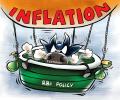
Currently, the retail inflation is well below the RBI's comfort level. The government has asked the central bank to keep inflation in the range of 4 per cent.

Corporate margins and profits in India remain vulnerable to changes in crude oil prices in the international market. Historical quarterly data from listed companies (excluding banks, finance and insurance, oil and gas, and power sectors) indicate an adverse correlation between corporate margins and crude oil prices.

Shrinking inflows and surging outflows on account of profit-booking has curtailed mutual fund (MF) investments in equities since April. The total investments made by equity MFs during the first three months of 2023-24 stands at just Rs 2,980 crore, compared with an average monthly investment of Rs 14,500 crore in 2022-23, reveals data from the Securities and Exchange Board of India. "We are seeing signs of moderation in non-systematic investment plan (SIP) contribution, which has impacted domestic fund inflows in recent months to some extent," says Kunal Vora, head-India equity research, BNP Paribas.
Domestic stock markets would be driven by inflation numbers, global trends, and the last batch of Q4 earnings this week, analysts said. Markets will also react to industrial production data and consumer inflation numbers that were released after market hours on Friday. "Participants will react to macroeconomic data viz. IIP and CPI first, which were released post-market hours on Friday.

More and more women are making their presence felt in jobs related to sciences, technology, and engineering across organisations.

Companies in the small-cap universe are having a dream run - the Nifty Smallcap 100 index has shot up more than 25 per cent on a year-to-date basis, even as the benchmark Nifty is up 7 per cent. This is the best start for the index since 2017 when the Nifty Smallcap 100 index surged 32.3 per cent between January 1 and May 10. However, in terms of outperformance to the Nifty, this year's performance is the best in more than a decade. A combination of sectoral tailwinds and lack of institutional selling pressure has helped small companies escape from the correction triggered by the second wave of Covid-19.
 © 2026 Rediff.com - Advertise with us - Disclaimer - Privacy Policy - Sitemap - Feedback - About us - Terms of use - Grievances